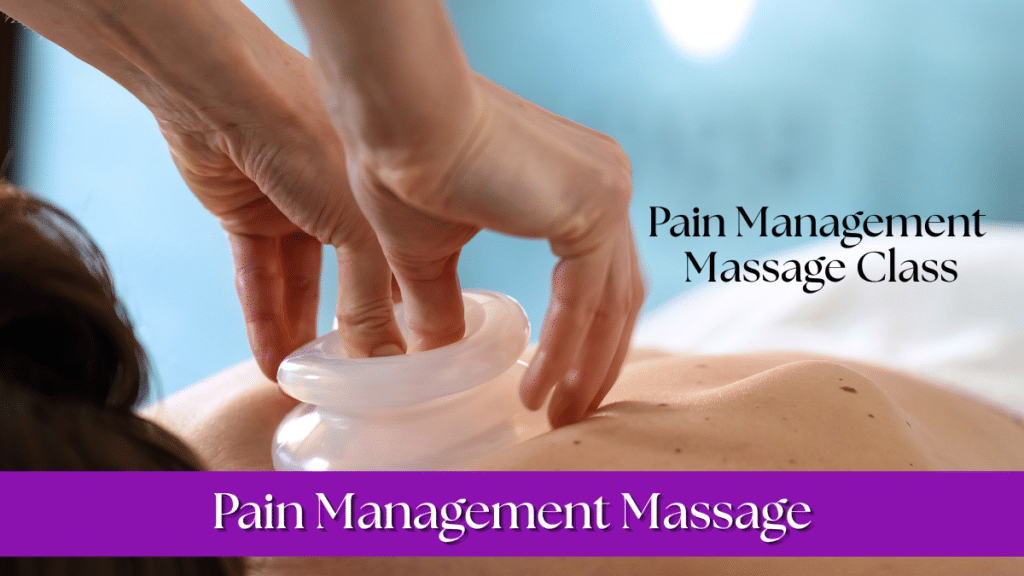
Pain Management Massage Class
Massage Classes
Self-Massage Class
This massage class teaches you how to self-massage to help alleviate pain when no one else is available to provide comfort and care. The massage techniques are customized to your needs and taught to minimize discomfort while you work toward pain relief.
Massage Therapy Course
This massage course teaches you how to massage someone else to help alleviate their pain when it’s needed most. Each session is customized specifically to the needs of each other so that you have the skill to soothe one another at a moment’s notice.
Massage Continuing Education
This massage continuing education course will reintroduce you to therapeutic massage. You will learn how to transform your quality of touch, how to analyze and improve the techniques you already use, how pain actually works, and how to develop your own awe-inspiring massage techniques that will help your clients feel better than ever.
Learn more about the massage theory behind this continuing education.
You Can Be Self-Sufficent
I want to help you live your best life, and the best way I believe to do that is by helping you learn the hands-on skills and knowledge you need to manage your pain in my absence.
One of the issues many pain neuroscientists, have with most types of passive therapies like massage is the tendency for people to become dependent on the treatment for pain relief. I don’t want you to be dependent on me, or any wellness practitioner; instead, I want you to be the one and only key to unlock the door to relief and peace.
This is why I offer pain management coaching and pain management massage classes in addition to manual therapy. I can’t be there with you every moment of the day when you might face discomfort, but you are. When you know how to self-massage, self-regulate, and reframe how you experience pain, you will always have a way to safely navigate.
You can take these classes on your own to learn self-massage, or as a couple so you can massage one another when you need it most.
Treat The CNS Like A Baby
The central nervous system (CNS) is like a baby, because the only way it knows how to communicate with us is by screaming. Unfortunately, when it screams, it manifests as pain. If a baby is screaming in her crib, would you scream back at her to get her to quiet down?
No, of course not; that would be counterproductive and would likely make her scream even louder.
When we approach pain management through massage, it is best to be gentle and caring to create a space that feels safe. In effect, we treat the CNS the same way we would a baby. Just like a baby crying in her crib, we offer kindness, patience, and ease. We want her to know she is safe and in good hands.
Once she begins to calm down, you can investigate what she needs. Does she need her diaper changed, or a new bottle? Then, once we have addressed her needs, we nurture her again and lay her back in the crib so she may once again fall asleep.
Art of Touch
When someone is hurting, treat them and their central nervous system like a baby. This means making sure they feel safe, comfortable, and cared for. Like a child, their brain needs to know they are in good hands.
When giving a massage, apply and withdraw your pressure slowly and gently. If you move in too quickly, it can startle the nervous system, which may cause the muscles to guard and protect against your touch.
To practice this, grab an unwrapped stick of butter and place your hand on top of it. Focus on the butter’s firmness and slowly push down. Make sure you are not smushing the stick; instead, let it melt slowly so your finger’s heat dictates your speed.
Another exercise is to take some firm clay and slowly press your fingers into it. This helps build patience and focus. Try to transform the clay into some kind of shape, and feel the pressure you apply as you change its state.
After you play with the clay for a little bit, massage and knead it like it were someone’s muscle. Adjust your pacing and intention to match the kindness you would offer a crying baby.
Be Mindful With Words
Be mindful with the words you use when describing your own sensations, and the assumptions you make about someone else’s body. This is especially important when discussing knots. If you feel something you think is unusual about how a muscle feels, try to refrain from trying to fix it with force. Most of the time, what you think is a muscle knot is not a knot.
By labeling an area a knot, you risk causing a nocebo effect in yourself or someone else. A nocebo is a negative expectation that makes an experience worse. Calling a tender spot a knot becomes nocebo-like when the word carries a threat story: this area is stuck, damaged, or needs to be forced loose.
If the term knot is used as shorthand for a spot that feels tender, it is unlikely to lead to nocebo. However, if a knot is used as proof of a structural abnormality, is massaged aggressively, or is labeled repeatedly until the area gains an identity, it can become a nocebo.
Nocebos are not maladaptive DIMs. For example, poor sleep, old fear of movement, or a memory of a bad flare can act as danger evidence without anyone suggesting harm. Nocebo is more than just evidence of danger in me; it is also the opposite of placebo, which can produce pain-relieving benefits via expectation.
Diagnostic and Somatic Labeling
While you might not be a doctor or an expert in anatomy and physiology, you can use words when massaging or touching someone that can cause them to develop positive and negative associations with their body.
This is partly due to the power differential that exists when one person is massaging another. This perceived power, and sometimes loaned expertise, may lead them to take your observations as fact rather than opinion. As a result, they may obsess over something you noticed and assign a negative association with it, which may lead to new or increased discomfort.
Instead of using phrases like, “Your back feels really tight,” or “You’ve got a really tough knot here,” ask them how an area feels, or use words that inspire and motivate their mind to make positive associations.
When they describe how an area feels, prompt them to use more descriptive, less emotionally charged words. This will help them build their somatic vocabulary so they can more accurately label the sensations they feel, over time reducing pain.
Disclaimer
Information provided on this website, including educational materials, pain neuroscience explanations, treatment suggestions, and any other content shared during sessions, classes, or coaching, is for educational purposes only. It is not intended to diagnose, treat, cure, or prevent any disease or medical condition, and is not a substitute for professional medical advice, diagnosis, or treatment.
You should always consult a qualified healthcare provider regarding any medical concerns. Never disregard professional medical advice or delay seeking it because of information you receive here.
O'Fallon Massage
Pain Management Massage Near Me
2717 Hwy K, O’Fallon, MO 63368