
Somatosensory Awareness

Explore Your Somatosensory Awareness
As you continue developing a relationship with your body, it helps to be familiar with a few key concepts that shape how your brain and body communicate. These include somatic awareness, somatic communication, somatic vocabulary, and somatic labeling.
Together, these terms help you understand how your nervous system turns sensory information into the sensations you feel. The diagram below gives a quick overview.
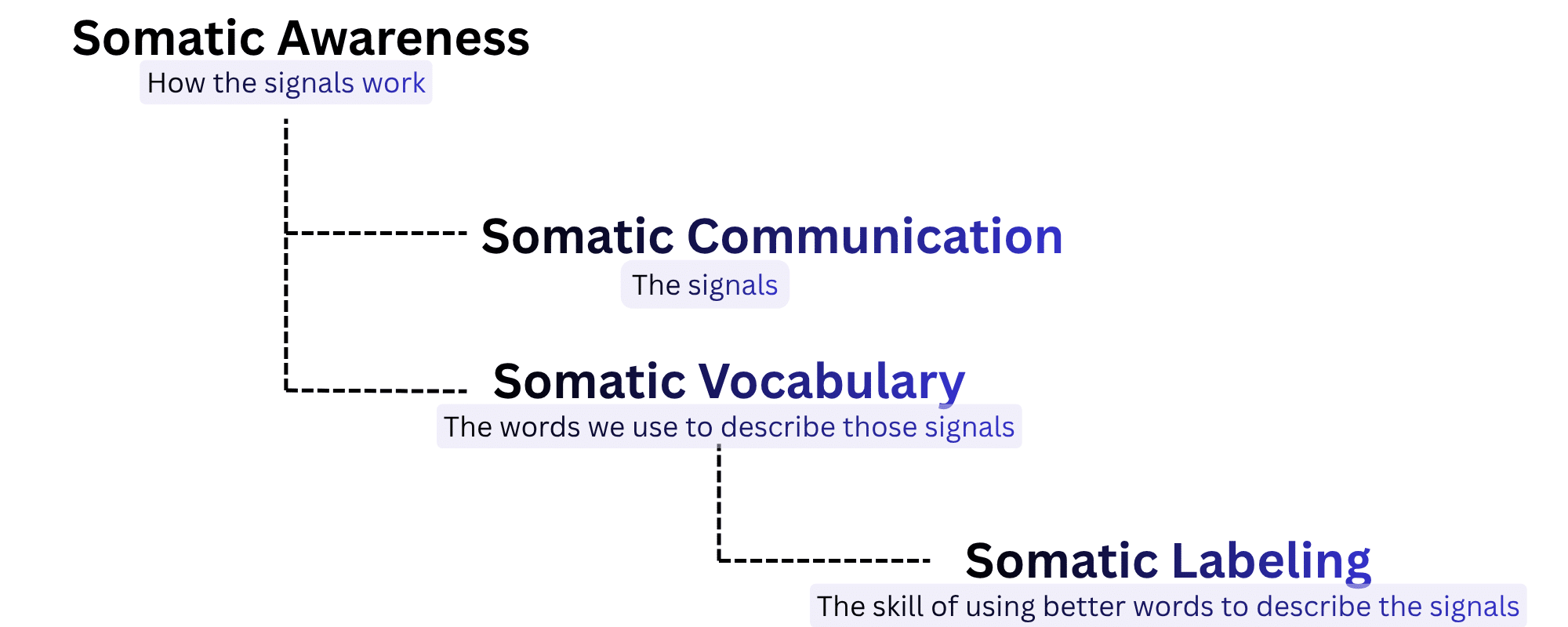
Somatic Awareness
Understanding how interoceptive, proprioceptive, and exteroceptive signals influence the brain, and how you can use your mind-body connection to affect them.
How does this information have a practical application? Imagine you are sitting at your desk and notice a growing tightness across your upper back and shoulders.
- Interoceptive Signals: You feel a sense of internal pressure and mild fatigue.
- Proprioceptive Signals: You become aware that your shoulders are raised and your spine is slightly forward.
- Exteroceptive Signals: The chair feels hard, the room is cool, and the screen is bright.
These signals reach the brain, which may interpret the overall pattern as “I’m under strain” or possibly “something is wrong.” That interpretation can increase muscle guarding and discomfort.
Using your mind-body connection, you can respond deliberately: you soften your shoulders, take a slower breath, adjust your posture, and remind yourself that this is simply fatigue and positioning, not danger. As those signals change, the brain receives new information: more ease, better support, slower breathing. The protective response settles, and the tightness eases.
Somatic Communication
The language your brain uses to translate interoceptive, exteroceptive, and proprioceptive data into internal sensations to notify or prompt a reaction from you.
How does this information have a practical application? Somatic Communication is the brain’s way of turning raw bodily data into a feeling you can notice so you will respond.
In practical terms, it is the moment when information from inside your body becomes a sensation that grabs your attention and urges you to do something.
Simple Breakdown
- Your body constantly sends data.
- The brain translates that data into an internal sensation.
- That sensation acts as a message: “Pay attention” or “Do something.”
Somatic Communication is how your system tries to guide you moment by moment. The better you become at noticing these messages, instead of overriding them or immediately treating them as threats, the more skillfully you can respond, and the less often the brain needs to escalate them into stronger protective signals.
Somatic Vocabulary
The glossary your brain uses to translate the interoceptive, exteroceptive, and proprioceptive data it receives from the body.
Somatic vocabulary is the set of words and distinctions your brain has available to describe what it is sensing in the body. In practical terms, it determines how a sensation gets translated into language, and that translation strongly affects how it feels.
Why does it matter?
If your somatic vocabulary is limited, most sensations get described with broad, emotionally loaded words such as:
- bad
- terrible
- unbearable
- something is really wrong
These words tend to increase threat.
When your somatic vocabulary is richer and more precise, the same sensation can be described in ways that carry less danger and provide more useful information.
- warm and spreading
- dull pressure on the right side
- a pulsing weight
- tight with electrical sensations
When you have a more expansive somatic vocabulary, your mind can creatively describe it so that it isn’t automatically identifying it as bad.
Somatic Labeling
The process of translating vague experiences of pain into data-driven sensory experiences. Its purpose is to remove negative emotional triggers and to help prevent catastrophizing.
Somatic Labeling is the practical skill of taking a vague, emotionally loaded pain experience and turning it into a clearer, more neutral sensory description. Precise sensory language gives the brain better data and usually lowers the threat level. This makes catastrophizing less likely and creates more room for a sense of safety.
To apply this practically, apply the following labels to each sensation:
- Where is it?
- What are the boundaries of it? What are its dimensions?
- What is its perceived mass?
- Does it move?
- Does it have an energy sensation?

Somatosensory Map
The somatosensory map is the brain’s representation of the body. If we saw this map, the experience would be unsettling, to say the least, because it is weird-looking.
Our nervous system doesn’t have eyes as we do, so it relies on the sensory data available to it. As a result, its mental image is of a bulbous, distorted figure with exaggerated features. It looks weird and disproportionate because the areas with higher receptor density and sensitivity appear larger.

Mind-Body Awareness
Our ability to self-regulate is significantly influenced by the insular cortex’s sensitivity.
Focus On The Feeling
Mindful Somatosensory Exercises
If you want to improve low interoception, consider the following exercises.
High or Low Interoception
- Low Interoception: People with low interoception may not notice internal signals until they become overwhelming. This may entail going all day without eating, forgetting to drink water, or being unable to identify why you feel irritable and anxious.
- High Interoception: People with high interoception may be hyper-aware of subtle fluctuations in hormone levels, digestive disruptions, and other internal functions. This may result in heightened sensitivity to stress, panic, or anxiety.
High and Low Interoception?
Is it possible to simultaneously have high and low levels of interoception? Yes! You can process different bodily signals to different degrees. It isn’t all one way or the other.
Increasing Lower Interoception
- Body Scans: Close your eyes and feel through every nook and cranny of your body. Explore the passive sensation from your toes to the tip of your nose.
- Mindful Movement: Move slowly and intentionally, stretch, and think about where you are in space. This can help you develop your hidden sixth sense: proprioception. Proprioception helps you identify where your body’s arms, legs, hands, etc., exist in space without visual confirmation.
- Mindful Breathing:Sit upright with your feet flat on the floor. Now focus on how it feels as you breathe. Where do you feel it most? Is it in your nostrils, is it the rising and falling of your chest, or perhaps in your abdomen? Allow your focus to land wherever it wants, hold back your desire to control it. Instead, celebrate how you naturally breathe in and out. Scan your body and explore every exquisite sensation. How does the air feel against your nose, over your lips, and across your tongue? Dive in and feel the moment. When your mind begins to wander, redirect it back to your next breath.
- Heartbeat Tracking: Sit comfortably with your eyes closed and quietly focus inwardly as you count the number of heartbeats you feel over a set period of time. Then, once the exercise is done, compare your actual heart rate to your count. Repeating this exercise helps you recalibrate your nervous system so your perception matches the physiological processes occurring within you. Heartbeat tracking can improve emotional regulation, intuition, decision-making, and support self-regulation during physical exertion.
- Massage: Rather than zoning out during a massage, pause and focus on what you feel during the session. Do your best to vocalize how each sensation feels. Most people do not have a rich sensory vocabulary, so if you are at a loss for words, start with the five basic massage sensations: pleasure, meh, hurts-so-good, rewarding, and pain. If you want to challenge yourself, try articulating each sensation; you can do this using sounds or even somatic metaphors. A somatic metaphor uses external physical actions to describe internal states. For example, it feels like my pain is a knot being unraveled.
Reducing Higher Interoception
If you want to reduce higher interoception, consider using the following exercises.
- 5-4-3-2-1 Sensory Grounding: Escape the cacophony of overstimulation by pausing, taking a breath, and identifying 5 things you can see, 4 things you can feel, 3 things you can hear, 2 things you can smell, and 1 thing you can taste.
- Focusing on the Soles of Your Feet: When you are feeling overwhelmed, direct your focus on the soles of your feet. Examine the temperature, pressure, and texture of the surface beneath you.
- Slow diaphragmatic breathing:When breathing, feel your lower belly expand as your chest and shoulders remain still. Feel the lower expansion of your ribs and diaphragm, then how your belly feels when the air passes through your nostrils.
- Vagus Nerve Stimulation:This may include cold plunges or showers, splashing ice-cold water on your face, or a cold compress to your neck. When your face or body is exposed to cold temperatures, it activates your parasympathetic response, which slows your heart rate and induces a state of calm.
Ready For The Next Step
There is a clearer, more supportive way to work with pain. Pain management coaching helps you understand what your body is communicating, increase feelings of safety, and respond to discomfort with greater confidence and ease.
Through Discovering Safety Within, you will receive practical guidance tailored to your experience, helping you move toward a calmer, more comfortable relationship with your body.
Learn more about pain management coaching and take the next step.
Jennifer Brand Spa
Pain Management at 2717 Hwy K, O’Fallon, MO 63368