
Patterns of Safety
Learn how to create patterns of safety to help retrain your brain so it knows it doesn’t need to create pain to protect you.
Safety
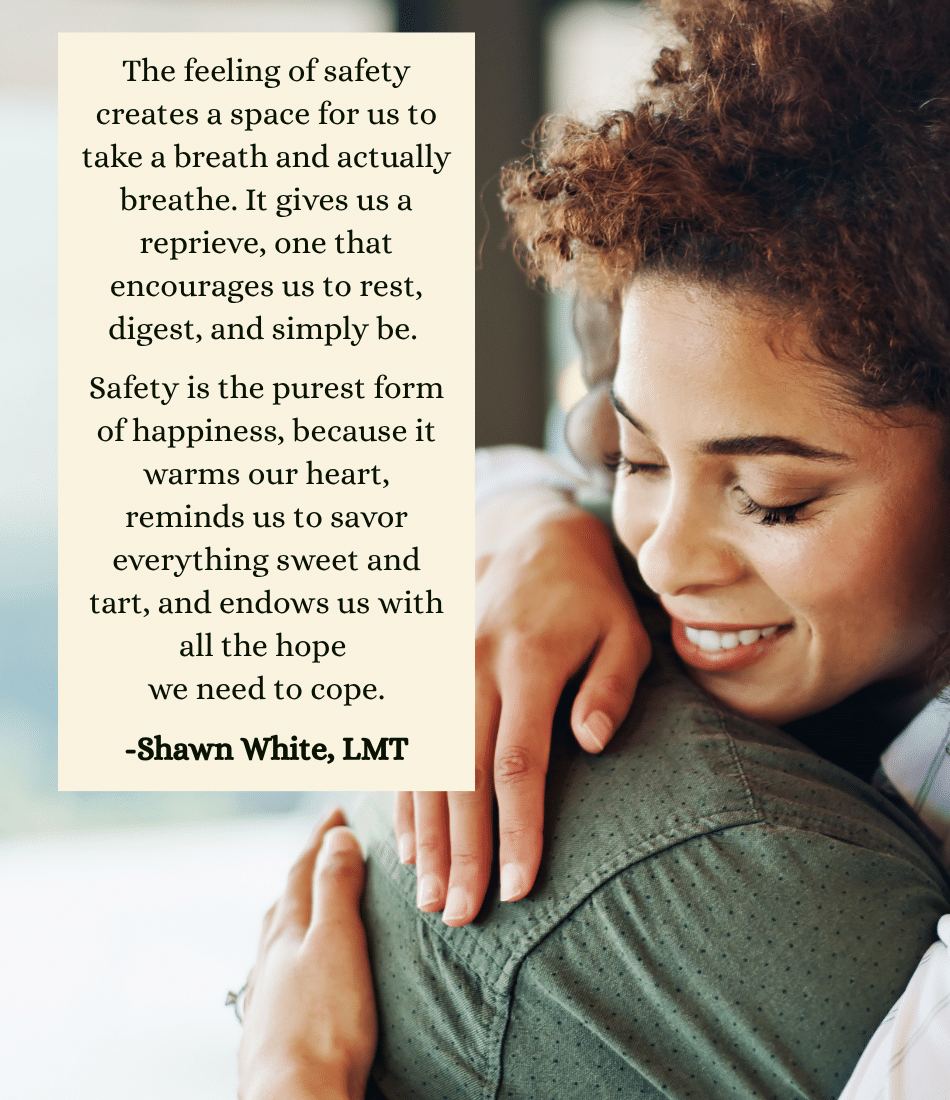
The feeling of safety creates a space for us to take a breath and actually breathe. It gives us a reprieve, one that encourages us to rest, digest, and simply be. Safety is the purest form of happiness, because it warms our heart, reminds us to savor everything sweet and tart, and endows us with all the hope we need to cope.
When you feel safe, it is because you know there is nothing to fear; you feel protected, provided for, and loved. It allows you to sit peacefully in the eye of the storm with a soft smile, even as chaos encircles you.
Living a rich, full life naturally flows from your ability to recognize signs of safety, reminding yourself that everything is going to be alright, and that no matter what happens, life is beautiful.
Why Is Safety Important For Pain Management?
The feeling of safety is what allows pain relief to occur. When your nervous system feels threatened, it often tries to protect you with pain; when it feels safe, it begins to lower its guard. The way you feel about life changes how you experience it.
Safety Patterns explores how to identify, cultivate, and create safety in your daily life, so you can experience natural pain relief.
Discovering Safety
You are going to find safety.
I know you are going to find safety, because inside your heart is more courage and bravery than you would ever believe. While you might be blind to it, I see someone who has overcome every challenge they have ever faced. You’ve been stepping up to the plate your whole life, sometimes hitting the ball out of the park, sometimes missing, but always finding your way to the next base.
This is how I know that if you set your mind to achieving a goal, you are going to reach it. I have faith that you are going to strive to live your best life, to reach for your dreams, and finally feel delightfully free.
Pain Management From Within
In pain management, the ultimate goal is the feeling of safety. While many people believe the goal is simple to “get out of pain,” chasing the absence of something rarely creates lasting results. True pain management begins when you make safety your primary focus, learning to know it, cultivating it, and maintaining it.
Safety is a personal experience that begins from within. You must find it within yourself before you can truly feel it anywhere else.

What is Safety?
For most, safety is the feeling that everything is okay. It’s a state of mind where you feel your body stop bracing, your shoulders drop, and you can lower your guard.
I think it is wise for everyone to ask themselves what safety means to them. How can you know you are safe until you have defined it?
It can be challenging to describe what safety is and how it feels when you are in an idle state. When I try to define it, I take myself to the safe space in my mind. To get there, I close my eyes and begin to imagine.
My Safe Space
I envision a beach. I am lying on a towel with my feet stretched out, covered in sand. Occasionally, I can feel the gentle waves make their way to my toe tips to tickle my skin.
The sun’s glowy golden heat feels warm and soothing as a calming breeze dances past me. I can hear the ocean, the birds, and the happy laughter of families having fun.
When I take myself to this place, my heart and soul feel like they are resting on a soft pillow. My spirit feels cherished, as the weight of the world is lifted from my shoulders.
The Feeling of Safety
Few people have the somatic vocabulary to translate what they are feeling into words. What matters is you know what safety feels like, so you can begin identifying it in your life.
If you cannot identify the ways you are safe today, how can you expect to recognize it tomorrow? And if you struggle to see your own safety when you are feeling at your best, how will you find it when you are at your worst?
What is Your Safe Space?
What does safety feel like to you?
I invite you to reflect on the moments and places where you already feel safe. Search your soul for those quiet spots where you feel enveloped in kindness, warmth, and love.
I want you to imagine a scene that feels magnificently serene. Feel the air on your skin, smell the scents around you, and explore every exquisite detail until you are fully immersed within your mind’s eye.
Express how this environment makes you feel. What emotions is it encouraging, and where do you notice those feelings in your body?
Note these sensations, because they are going to serve as your primer for knowing what safety feels like, so you can identify them in your daily life.
Why Are SIMs So Powerful?
Providing your brain with repeated evidence of safety strengthens your safety-related neurotags. Over time, these safety signals can inhibit or override pain-producing neurotags as your brain learns it no longer needs to protect you as aggressively.
- Desensitization and habituation: In conditions like allodynia or hyperalgesia, the nervous system becomes overly protective. Safe, repeated exposure through SIMs helps normalize sensory processing, reduces sensitization, and gently retrains your brain’s cortical maps.
- Reduced threat perception: Pain is strongly influenced by the brain’s overall sense of threat. Consistent SIMs lower fear of movement or reinjury, decrease catastrophizing, and build self-efficacy.
- Neuroplasticity in action: Your brain is constantly updating based on experience. Regular safety signals help reprogram the neuromatrix so everyday activities no longer trigger strong pain responses. This is why the benefits of SIMs usually build gradually rather than appear in a single session.
Mapping SIMs
Once you know what safety feels like, you can begin identifying the SIMs (Safety-In-Me) in your daily life. These can be the people, places, practices, and moments that invite peace into your day.
Engaging with your SIMs can interrupt catastrophizing thoughts, reduce anxiety, and support a calmer, more pleasant, and balanced emotional state. Over time, regularly connecting with your SIMs helps to reduce the effects of central sensitization, lowering pain amplification.
I invite you to map out and journal about your SIMs. This practice will help you notice patterns of safety, develop effective coping strategies, and find new ways to enhance your quality of life.
When writing about your SIMs, consider these distinct categories:
- Things you do: What activities help you feel grounded, calm, and capable? Examples: Mindfully watering your plants or sitting on the porch watching the sunset.
- Things you say: What words or affirmations help you feel better? Examples: “Everything is going to be okay,” or “Life is beautiful.”
- Things you think or believe: What deeply held opinions or beliefs positively influence how you feel? Examples: “Rest is productive,” or “I am not my pain.”
- Places you go: What environments help you relax and feel at ease? Examples: A sunny spot on the couch, or a quiet walking path.
- People in your life: Who helps you feel seen, heard, validated, and safe? Examples: A friend you can be honest with, or a pet that greets you enthusiastically.
- Things happening in your body: What internal sensations signal health, comfort, and safety? Examples: The cool sensation of lotion against your hands, or a soft sigh of relief.
- Objects in your world: What tangible items bring you comfort and represent safety? Examples: A cozy pair of socks, or a journal you enjoy writing in.

New SIMs
You don’t need to have a complete map of your SIM universe written down before you start creating new ones. Once you know what safety feels like, you can begin building and strengthening your own, one moment at a time.
Natural Pain Relief
When creating a new SIM, think about what you would like it to be. Would you like it to be an activity you do, something you say, a thought or belief you hold, a place you go, a person in your life, a comforting sensation in your body, or a tangible object that represents safety?
Pick something that already feels natural and effortless to you. The easier it is for you to create it, engage with it, and interact with it routinely, the more effective it will be.
Here are some examples to get your ideas flowing:
- Things you do: Taking a warm shower, doing gentle stretches, petting your dog, or drinking tea slowly.
- Things you say: “I am safe right now,” “This sensation is uncomfortable, but not dangerous,” or “I’ve handled challenging things before.”
- Things you think or believe: “My body is doing its best to protect me,” or “I am capable of handling this moment.”
- Places you go: Your favorite chair by the window, a quiet corner of the garden, or the local library.
- People in your life: A supportive friend who listens without trying to fix you, your spouse when they offer you a hug, or a caring therapist.
- Things happening in your body: The warmth spreading through your hands on a heating pad, slow, steady breathing in your tummy, or the feeling of your feet on the ground.
- Objects in your world: A favorite soft blanket, a weighted eye pillow, a meaningful piece of jewelry, or a smooth stone you keep in your pocket.
Novelty or Nostalgia?
Your new SIM can be something fairly new to you or drawn from your past. No matter what you choose, it should be free of negative associations and carry at least some degree of historical peace or positive resonance.
Anchor Pain Relief to Safety
New SIMs are often easier to create when you connect them to an already safe routine. By habit stacking in this way, you weave the safety neurotag more deeply into your daily life.
Here are some simple ways you can anchor your new SIMs to safety:
- While drinking your morning coffee or tea, intentionally place your hand on your heart and take three slow breaths.
- After brushing your teeth at night, wrap yourself in your favorite soft blanket for one minute of quiet gratitude.
- While waiting for your car to warm up, listen to your favorite calming song and feel your feet on the floor.
- During your daily shower, focus on the sensation of the warm water and silently repeat “I am safe.”
Patterns of Safety
Building SIMs is a powerful, ongoing practice in pain management. Great change doesn’t happen in a day; be patient with yourself by starting small and remaining consistent. Over time, these safety patterns can have a profound impact on how your mind and body experience life.
You’ve already taken a meaningful step by reading this and beginning to explore your own safety. Keep going; your nervous system is listening. Brighter and calmer days are on their way.
A Bright Future
You are going to do more than find safety; you are going to create it within yourself. Soon, you will become a bright and nimbus light that shines so bright that the ships of the sea will come to you to find their way through the night storm. Your heart will be full of hope, you will have the tools to cope, and your body will finally feel like home.
Disclaimer
All information provided on this website, including, but not limited to, educational materials, pain neuroscience explanations, treatment suggestions, and any other content shared during sessions, classes, or coaching, is for educational purposes only. It is not intended to diagnose, treat, cure, or prevent any disease or medical condition, nor is it a substitute for professional medical advice, diagnosis, or treatment.
You should always consult a qualified healthcare provider for medical concerns, and never disregard professional medical advice or delay seeking it because of information you receive here.